White paper
The verifiable AI stack: A governance-first architecture for UK professional services SMEs
A governance-first framework for turning fragmented institutional knowledge into a verifiable, defensible, and commercially valuable AI capability for regulated UK firms.
Introduction: Bridging the UK’s GenAI divide
For UK small and medium-sized enterprises (SMEs) in the professional services sector – including legal, accountancy, and financial services – a significant “GenAI divide” has opened between the hype surrounding Artificial Intelligence and the complex operational reality for regulated firms. Many are finding themselves drowning in information, where decades of accumulated documents, case files, and client correspondence have transformed their institutional knowledge from a core asset into a fragmented and chaotic liability. This information overload creates a barrier to efficient, competitive practice in an increasingly digital marketplace.
The path forward is not to fear this information, but to reforge it. This white paper argues for a governance-first architecture called the Verifiable AI Stack that transforms this institutional liability back into a verifiable, secure, and profitable asset. This approach systematically de-risks the use of AI by embedding auditable controls directly into the workflow, ensuring that every output is grounded in authoritative, firm-approved sources.
This document provides senior stakeholders with an evidence-based framework for de-risking AI adoption and transforming their firm’s knowledge into a verifiable, secure, and profitable asset. It outlines a technical and procedural model that aligns with the stringent duties of care owed by regulated professionals and the explicit expectations of UK and EU regulators. By adopting this stack, firms can move beyond the hype and begin a safe, methodical journey towards AI-powered productivity.
This journey begins with a clear-eyed assessment of the inherent risks of using general-purpose AI in a regulated context.
1. The governance gap: Why generic AI is unsuitable for regulated professional services
This section addresses the fundamental conflict between the operational nature of generic Large Language Models (LLMs) and the non-negotiable duties of care owed by regulated professionals. For a law, accountancy, or financial services firm, adopting AI is not merely a technological decision but a matter of professional integrity and regulatory compliance. The architecture of generic, public-facing AI tools presents critical inadequacies that expose firms to unacceptable levels of legal, financial, and reputational risk.
Accuracy and provenance
The most widely publicised risk of generic LLMs is hallucination – the tendency for models to generate confident but factually incorrect or entirely fabricated information. For regulated professionals, whose advice must be precise and evidence-based, this is a catastrophic and professionally disqualifying failure.
The UK High Court has issued a stark condemnation of the use of fake legal authorities generated by AI in court submissions, warning that such actions can lead to severe consequences, including contempt of court. Dame Victoria Sharp, President of the King’s Bench Division, has explicitly cautioned that AI tools may make confident assertions that are simply untrue, placing the professional duty of verification squarely on the shoulders of the practitioner.
Fairness and bias
AI systems trained on vast historical datasets run the substantial risk of reflecting and amplifying long-embedded systemic inequalities. In financial services, this can manifest as algorithmic discrimination, where models trained on biased historical lending data lead to unfair credit denials for marginalised communities.
This not only violates ethical principles but also conflicts with regulatory mandates from bodies like the Information Commissioner’s Office (ICO) and the Financial Conduct Authority (FCA), which demand fairness in automated processing and decision-making.
Client confidentiality
The duty to protect client confidentiality is a cornerstone of professional service. Yet the use of unapproved consumer AI tools presents a significant risk of data leakage. A recent survey found that 71% of UK employees report using such tools at work, often without enterprise-grade security controls.
When sensitive client information is entered into public AI platforms, firms lose control over that data, creating a direct risk of exposing confidential material in violation of professional duties (for example, SRA rules) and data protection laws like UK GDPR.
Accountability and auditability
In the event of a client dispute or professional negligence claim, a firm must be able to demonstrate diligence and professional supervision. Generic AI tools often create an audit log black hole, failing to record the specific queries a professional asked the system.
This inability to reconstruct the analytical process makes it impossible to provide an evidentiary record of the work performed, critically undermining the firm’s ability to defend its actions. Without a clear and transparent audit trail, accountability becomes an aspiration, not a demonstrable reality.
2. The verifiable AI stack: A solution built for trust and compliance
The Verifiable AI Stack is the architectural and procedural solution to the governance gaps inherent in generic AI. It is a framework designed to embed trust, traceability, and human accountability into AI-powered workflows by design, transforming AI from a source of risk into a reliable tool for professional decision support. It provides a defensible and compliant method for firms to leverage their own institutional knowledge securely.
The core technical principle of the stack is source-grounding, a technique also known as Retrieval-Augmented Generation (RAG). This architecture fundamentally changes how the AI model generates responses. Instead of drawing from its vast, opaque training data, the model’s answers are based exclusively on a specific set of curated and authoritative information provided by the user for a given task. This creates a self-contained universe of information for each matter, ensuring that every output is directly tied to the firm’s approved sources.
Key mechanisms of the verifiable AI stack
- Retrieval-Augmented Generation (RAG). This is the engine of verifiability. By grounding all responses in a curated knowledge base, RAG acts as a direct and powerful countermeasure to hallucination. If the information required to answer a question is not present in the uploaded source documents, the tool will indicate that it cannot provide an answer, preventing the generation of fabricated content.
- Citation fidelity. Every piece of information generated by the AI is accompanied by clear, in-line citations that link directly back to the exact quotes or passages in the original source documents. This provides an immediate and transparent audit trail, allowing a professional to instantly verify the provenance of every statement and ensuring that the final work product is built on a foundation of verifiable facts.
- Curated knowledge bases. The architecture encourages professionals to create dedicated, secure notebooks for each matter or project. By uploading only relevant and authoritative documents – such as case files, client correspondence, or regulatory guidance – the system naturally aligns with the data protection principles of data minimisation and purpose limitation.
- Mandatory human oversight. The stack is a decision-support architecture, not an autonomous replacement for professional judgment. A human-in-the-loop architecture is a non-negotiable professional and ethical red line. Every AI-generated output must be treated as a first draft, subject to critical review and verification by a qualified professional before it is relied upon for any professional purpose.
- Comprehensive audit trails. To ensure full accountability, the stack requires the maintenance of detailed logs of AI interactions. This aligns with emerging regulatory mandates, such as the EU AI Act’s requirement for logging of activity to ensure traceability in high-risk systems, providing a defensible record of how and when AI was used.
This architectural approach is not a theoretical construct; it is a practical implementation of globally recognised governance standards. The stack’s emphasis on risk management, auditable processes, and continual improvement directly aligns with the management system framework of ISO/IEC 42001:2023. Its focus on mitigating specific generative AI risks like hallucination through measurable controls such as the Citation Fidelity Rate directly answers the call for verifiable measurement methods within the NIST AI Risk Management Framework (AI RMF).
This combination of technical and procedural controls creates a robust framework for responsible AI adoption. The next section deconstructs this framework into its five distinct operational layers.
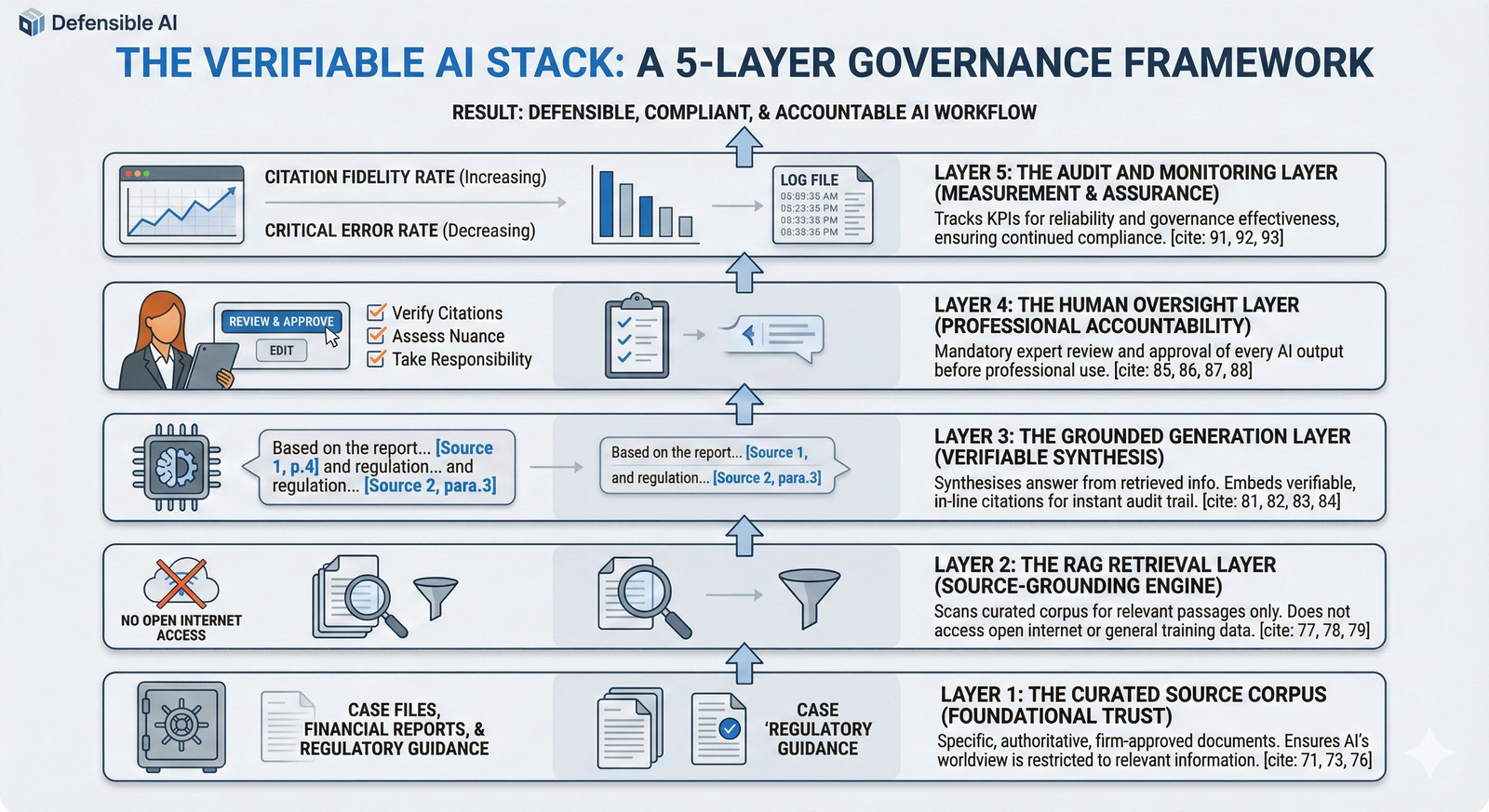
3. The five layers of the verifiable AI stack
The Verifiable AI Stack is not a single piece of technology but a multi-layered system comprising both technical and procedural controls that work in concert to ensure trust and compliance. Understanding these five layers is crucial for any SME seeking to implement a robust and defensible AI strategy that can withstand regulatory scrutiny and protect the firm from operational risk.
Layer 1: The curated source corpus
This is the foundational layer of trust. It consists of the specific, authoritative documents selected by the professional for a given task – for example, the complete set of case files for a legal matter, the financial reports and client emails for an audit, or the relevant regulatory guidance for a compliance query. The quality, accuracy, and completeness of all subsequent outputs depend entirely on the integrity of this user-curated knowledge base. This layer ensures that the AI’s worldview is restricted to firm-approved, relevant information.
This curated scope approach is a deliberate governance decision. It stands in contrast to comprehensive scope architectures that ground AI responses in a user’s entire digital estate (emails, chats, and files). While powerful, the latter approach risks context contamination, where sensitive information from an unrelated matter could be inadvertently surfaced. By mandating a curated corpus for each task, the Verifiable AI Stack architecturally enforces the principles of purpose limitation and data minimisation, a critical safeguard for regulated work.
Layer 2: The RAG retrieval layer
This layer acts as the source-grounding engine. When a user poses a query, the RAG retrieval layer scans the curated source corpus and retrieves only the most relevant passages of text needed to answer the question. It does not access the open internet or the AI model’s general training data. Its sole function is to provide the next layer with a focused, contextually relevant packet of information drawn exclusively from the approved sources.
Layer 3: The grounded generation layer
Here, the AI model synthesises an answer based only on the specific information provided by the retrieval layer. It is architecturally constrained from introducing outside knowledge. Critically, this layer embeds verifiable, in-line citations directly into the generated text. Each statement or summary is linked back to its precise origin in the source documents, creating an immediate and unbreakable audit trail and allowing for instant human verification.
Layer 4: The human oversight layer
This is the mandatory procedural control layer that ensures professional accountability. It requires a human expert to critically review, edit, and approve every AI-generated output before it is used for any professional purpose. This process is formalised through tools such as a mandatory reviewer checklist, which obligates the professional to verify citations for accuracy, assess the final interpretation for nuance and correctness, and ultimately take professional responsibility for the final work product.
Layer 5: The audit and monitoring layer
This is the measurement and assurance layer that proves compliance and demonstrates return on investment over time. It relies on specific Key Performance Indicators (KPIs) to track the system’s reliability and the effectiveness of the governance framework. Two essential KPIs include:
- Citation Fidelity Rate (CFR). The percentage of factual outputs that can be successfully and accurately traced back to an authorised source document via their citations.
- Critical Error Rate (CER). The frequency of AI outputs that, upon expert human review, are identified as containing errors that could lead to breaches of professional duties or other significant risks.
Together, these five layers provide a comprehensive technical and procedural architecture that directly aligns with the specific mandates of UK and EU regulators.
4. Aligning with UK and EU regulatory expectations
Adopting a Verifiable AI Stack is not just an exercise in good corporate governance; it is a direct and proactive response to the explicit requirements of UK and EU regulators. For professional services SMEs, demonstrating this alignment is critical for mitigating compliance risk.
Regulators across all sectors are converging on a core set of principles for AI: accuracy, fairness, transparency, and accountability, moving from abstract guidance to a future of binding legal duties. The stack is architected to provide tangible assurance against each of these principles.
How the verifiable AI stack provides assurance
- Information Commissioner’s Office (ICO) – accuracy and fairness. The stack directly addresses the ICO’s accuracy principle by using RAG to ground outputs in factual source documents, minimising the risk of generating incorrect or misleading information. The Citation Fidelity Rate (CFR) provides a measurable metric to demonstrate ongoing accuracy.
- Solicitors Regulation Authority (SRA) – professional competence and confidentiality. By mitigating the risk of citing fake legal authorities and ensuring all information is verifiable through citations, the stack helps lawyers meet their fundamental duty of competence. Enterprise-grade security controls and curated knowledge bases architecturally restrict data access, upholding the strict client confidentiality rules mandated by the SRA.
- Financial Conduct Authority (FCA) – model risk management and Consumer Duty. The stack provides a robust framework for managing model risk by ensuring inputs are from a controlled, curated corpus and that all outputs are explainable via citations. This transparency helps firms demonstrate they are acting to avoid foreseeable harm to consumers, a core tenet of the Consumer Duty.
- EU AI Act – transparency and traceability. The stack’s architecture directly supports the Act’s requirements for high-risk AI systems. The explicit audit trail created by in-line citations and the mandatory logging of activity (as part of the audit and monitoring layer) ensure the deep levels of traceability and transparency the regulation demands for demonstrating compliance.
The consistency across these regulatory bodies reveals a clear trajectory: any professional firm using AI will be expected to demonstrate, with evidence, how its systems ensure verifiable and accountable outcomes. The Verifiable AI Stack is architected to generate this evidence by design, transforming compliance from a reactive checklist into a proactive, demonstrable capability.
5. Practical applications for UK professional services SMEs
The strategic value of the Verifiable AI Stack lies not in its technical elegance, but in its practical application to the core, information-intensive workflows of professional services. By transforming chaotic, fragmented knowledge into a secure and queryable asset, the stack solves persistent operational challenges and unlocks new opportunities for growth and efficiency.
Law firms: The case intelligence engine
Legal SMEs are beset by inefficiencies that directly impact profitability. Fee-earners waste significant non-billable hours on chaotic information retrieval, searching for documents across fragmented servers, local drives, and email chains. This is compounded by the high risk of malpractice from version-control errors, where an outdated draft can lead to an incorrect court filing.
A Verifiable AI Stack addresses these pains by functioning as a centralised case intelligence engine. By creating a dedicated, secure notebook for each matter and uploading all pleadings, deposition transcripts, client emails, and research, the tool becomes an instant expert on the case. This allows lawyers and paralegals to ask complex questions such as “Summarise all instances where the witness contradicted their initial statement” and receive an immediate, synthesised answer with direct citations to the exact page and line in the source documents.
Accountancy firms: The advisory scaling platform
Key challenges for accountancy SMEs include knowledge hoarding with senior partners, the ongoing commoditisation of compliance work, and intense pressure to scale higher-margin advisory services.
The Verifiable AI Stack addresses this by acting as an advisory scaling platform. It democratises the firm’s most valuable asset – its internal expertise – by capturing it in a queryable knowledge base. Junior staff can securely query a repository of past reports, anonymised client data, and HMRC guidance to confidently handle complex queries. This frees up senior partners from repetitive information gatekeeping, allowing them to focus on high-value strategic work and client relationships, thereby scaling the firm’s advisory capacity.
Financial services SMEs: The model risk mitigation framework
Financial services SMEs operate under a strict regulatory imperative to manage model risk, ensure fair lending practices, and maintain explainability for compliance audits, such as suspicious activity reporting (SARs) required under UK anti-money laundering regulations.
The Verifiable AI Stack provides a robust framework for mitigating these risks. By grounding models in a curated corpus of approved policies, internal rules, and validated data, firms can prevent algorithmic bias in lending decisions. Furthermore, the stack ensures that every decision – such as a flagged transaction – can be explained and traced back to a specific source rule or data point, satisfying the rigorous demands for auditability from the FCA and other regulators.
6. The commercial case: Verifiable AI as the safest, most cost-effective pathway
The Verifiable AI Stack is the mechanism for turning the liability of fragmented knowledge back into a balance-sheet asset. For any SME, technology investment must be justified by a clear and compelling business case that goes beyond features to demonstrate a tangible return on investment.
The Verifiable AI Stack presents the most prudent commercial strategy for AI adoption by shifting the primary value proposition from simple efficiency gains to comprehensive risk mitigation and the protection of institutional value. The core pitch is straightforward: protect and monetise your firm’s most valuable asset – your institutional knowledge.
A sample pilot business case
- Investment. A £15,000 pilot project focused on a single practice group or department.
- Return. The system saves 200 billable hours per year through dramatically faster and more accurate information retrieval.
- Quantified value. At a conservative blended rate of £200 per hour, this translates directly to £40,000 in recovered billable time.
- Payback period. The pilot project pays for itself in under five months.
Three core commercial benefits
- Direct profitability. The most immediate benefit is the conversion of non-billable administrative time spent searching for information into profitable, fee-earning work. By slashing the time it takes to find critical facts, firms can increase utilisation rates and directly boost revenue.
- Strategic scaling. The stack transforms dormant, siloed documents into an interactive and scalable asset. This protects the firm against knowledge loss when senior personnel retire or depart, and it dramatically accelerates the onboarding and time-to-productivity of new staff by giving them an intelligent guide to the firm’s collective expertise.
- Risk mitigation. By embedding compliance, verifiability, and human oversight into its architecture, this approach is definitively the safest and most cost-effective path to AI adoption. It systematically avoids the significant financial and reputational costs of regulatory sanctions or professional negligence claims that can arise from the misuse of inaccurate, unaccountable generic AI tools.
To begin this journey, stakeholders can follow a clear, phased checklist designed to ensure a successful and low-risk implementation.
7. A phased adoption checklist for SME adoption
This section provides a practical, actionable guide for senior stakeholders to navigate AI adoption. A successful, low-risk implementation is not a single event but a predictable, phased journey from initial discovery to a governed, scaled rollout. Each phase includes clear go or no-go gates to ensure that the project remains aligned with business objectives and risk tolerance at every stage.
Phase 1: Offer discovery and readiness (1–2 days)
- Designate an internal transparency champion responsible for overseeing the principles and practice of AI adoption.
- Map all candidate internal knowledge sources (for example, document management system, key reports, policy manuals) for a potential pilot.
- Define the initial access and sharing rules for a small-scale, internal-only pilot group to ensure confidentiality.
- Draft a high-level AI use policy outlining the core principles of mandatory human oversight and the verification of all AI-generated outputs.
- Secure sign-off from key stakeholders (for example, managing partner, DPO, head of risk) to proceed to a controlled pilot.
Phase 2: The pilot (2–4 weeks)
- Select one or two high-value, low-risk internal use cases (for example, synthesising the firm’s internal policies for HR, analysing past marketing materials for insights).
- Create a pilot notebook with a curated set of 20–50 relevant, non-sensitive documents to test the system’s capabilities.
- Provide hands-on training for a small pilot group (5–10 users), focusing on responsible prompting and the mandatory use of the mandatory reviewer checklist.
- Collect structured user feedback and measure baseline metrics (for example, time taken to find specific information before and after implementation).
- Conduct a formal go or no-go review based on pilot feedback and initial metrics to decide whether to proceed with a wider rollout.
Phase 3: Governed rollout and scaling
- Finalise the full governance model, including completing a Data Protection Impact Assessment (DPIA) before any client data is introduced.
- Implement enterprise-grade technical controls (for example, enforceable UK or EU data residency, advanced access management) before introducing sensitive or client-identifiable information.
- Develop a train-the-trainer programme to scale user onboarding efficiently and consistently across the firm.
- Embed success metrics (for example, Citation Fidelity Rate, time-to-answer) into operational dashboards to track ongoing usage and return on investment.
- Schedule a 30-day post-rollout review to assess adoption rates, address any emergent issues, and make necessary corrections to the strategy.
Conclusion: The responsible path to competitive advantage
For regulated UK SMEs, the question is no longer whether they will adopt AI, but how. Attempting to do so with generic, ungoverned tools is a path fraught with unacceptable risk. The Verifiable AI Stack provides the blueprint to master this complexity, transforming the chaotic liability of institutional knowledge into the firm’s most powerful and profitable competitive asset.